Check what is in the vial yourself.
A plain guide to choosing tests, picking a laboratory and making sense of the certificate you get back, linked to the lab reports already published on Peptide Trades.
What testing means
A test puts a sample through laboratory analysis to check its identity, composition and quantity against a set standard. Those measurements, not a label or a sales page, are the basis for judging a product.
A seller-supplied certificate of analysis
- The seller picks the lab and pays for the work
- Usually covers a production batch rather than your own vial
- May not be impartial
Third-party (3P) testing: you choose the lab and send your own vial
- The sample is the vial that actually arrived
- Checks identity and the quantity of active ingredient (API)
- Supports a claim while an order sits in escrow
Testing as a group
Several buyers holding the same batch each send a vial and share the lab fees. Each person pays less, and the results describe the batch far more clearly.
- Covers the batchA single vial reading 5% low proves little by itself, because the next vial could match the label or exceed it. Averaging several vials gives a truer mg-per-vial figure.
- Lower cost for each personSplitting the fees puts purity, quantity and endotoxin panels within reach of every member.
- Results belong to the groupMembers can hold results back for a few weeks as a benefit to those who funded them, publish straight away, or keep them private. Pooled data on brands is useful to everyone.
Choosing tests
Every vendor has, at some point, shipped the wrong peptide, the wrong amount or a degraded product. The usual causes are weak quality control, poor raw materials and careless finishing. The tiers below set out which checks to run, and at what frequency.
Identifies the peptide, measures its purity and reports the mg of API in the vial (for example, 30 mg of tirzepatide).
Why it matters
Purity tells you how well the peptide was made and whether it has held up, with little deamidation. The quantity figure shows whether the vial holds what the label states. Request the raw data so anyone can check the calculation. For background on purity in this market, see this guide .
Measures bacterial endotoxin. Filtering can remove bacteria, but it does not remove endotoxins.
Why it matters
Endotoxins are mostly lipopolysaccharides (LPS) shed by gram-negative bacteria. Solid-phase peptide synthesis is not expected to produce them, yet few vendors publish how they manufacture or to what standard. A Limulus Amebocyte Lysate (LAL) assay shows whether levels fall within the limit.
Looks for trifluoroacetic acid. TFA is a solvent used during synthesis, and it can also remain in the product as a lower-cost counterion salt.
Why it matters
Producing the TFA salt costs less than producing the acetate or sodium forms, so a brand could switch to it without saying so. Running NMR F-19 from time to time picks up that kind of change. See Residual Solvents for more.
Covers arsenic, cadmium, lead and mercury. These play no part in peptide synthesis, so testing now and then is usually enough.
Why it matters
Heavy metals have no place in a peptide product at any level. Occasional checks confirm whether any are present.
Before paying for a test, check the lab reports on Peptide Trades. A recent certificate for the same brand and batch may already be there.
An NMR F-19 check for TFA works as the practical stand-in.
The detail
The SPPS solvents DCM, DCA, DMF, ACN and NMP fall in Class 2, and correct lyophilisation removes them. Class 1 solvents have no known role in SPPS. Every one of them boils below 85 °C, so it is very unlikely any would survive vacuum drying (ICH Q3C ). When no TFA is detected, Class 1 residues are almost certainly missing as well.
Choosing a lab
HPLC and NMR are offered by plenty of local laboratories, university labs among them. The three below are widely used by buyers in the US and elsewhere.
- HPLC: offered
- NMR F-19: offered
- Endotoxin: offered
- Heavy metals: offered
- HPLC: offered
- NMR F-19: not offered
- Endotoxin: offered
- Heavy metals: not offered
- HPLC: not offered
- NMR F-19: offered
- Endotoxin: not offered
- Heavy metals: not offered
Reading results
For each test: the pass mark, how the lab arrives at its figure, and two calculators for checking the numbers yourself.
HPLC
HPLC reflects the quality of the synthesis and how stable the peptide has remained, since the purity figure takes degradation into account. Our benchmark is above 98%, the same level used in FDA-regulated 503A/B compounding. The method also measures how much API is present. We treat ±10% as acceptable, which is what many vendors promise. USP <905> permits a batch to vary by ±15%, provided no individual unit is more than ±25% away from target.
Each HPLC method is calibrated to one specific peptide using a reference standard . When that peptide is missing, no peak appears at all. When it is present, a peak shows up at the expected retention time (RT), and the area under the curve (AUC) is used to work out purity and quantity. Small peaks close by are normally degraded peptide (deamidation) or compounds of similar size, and they usually count toward the purity figure.
Not every lab treats those small peaks the same way. Most count degraded peptide. Some leave out peaks they label as unidentified filler. Known fillers such as mannitol, added to stabilise the product during freeze-drying, are always excluded. Ask for the raw data every time, because it normally explains why two labs report different purities.
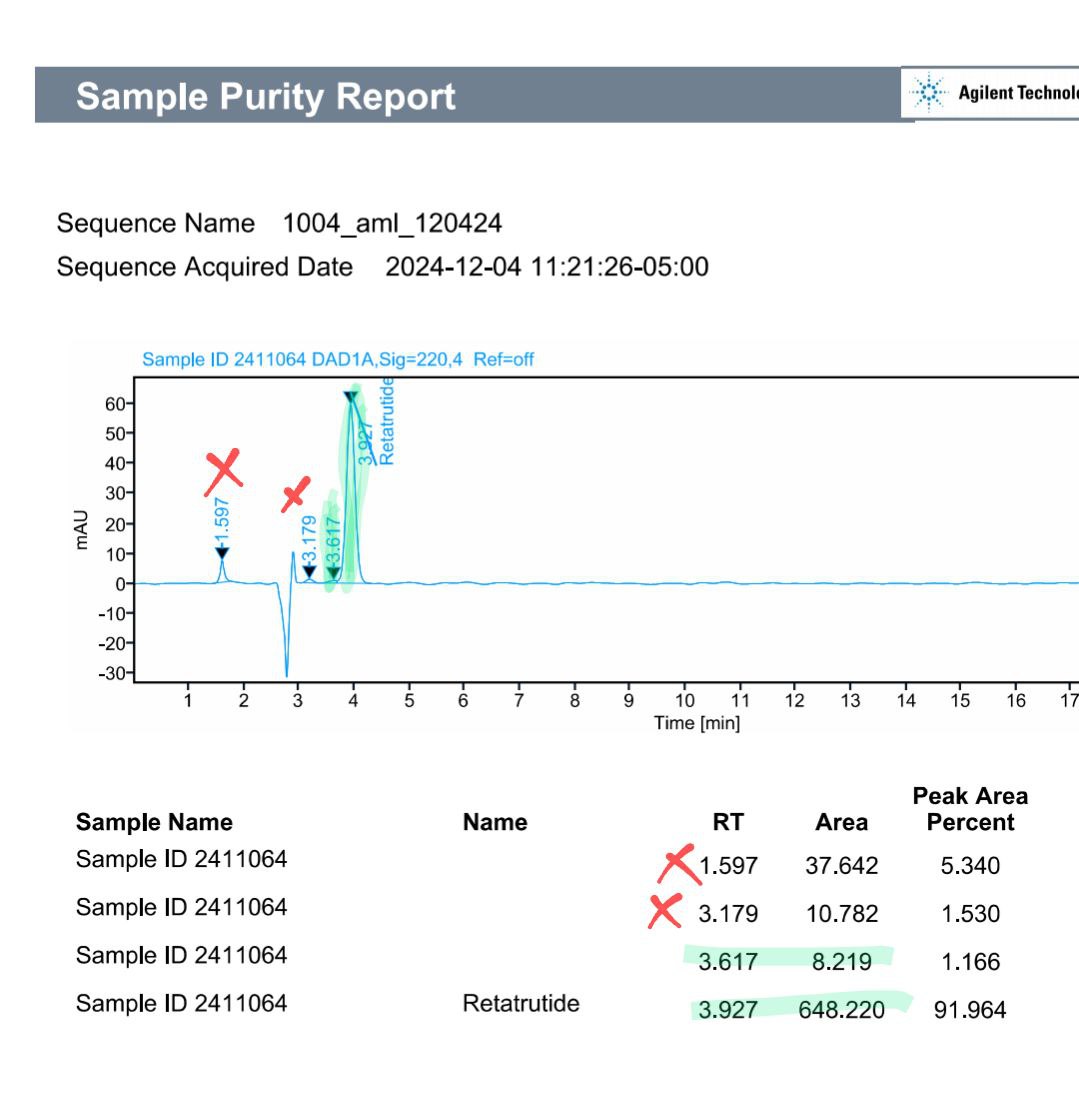
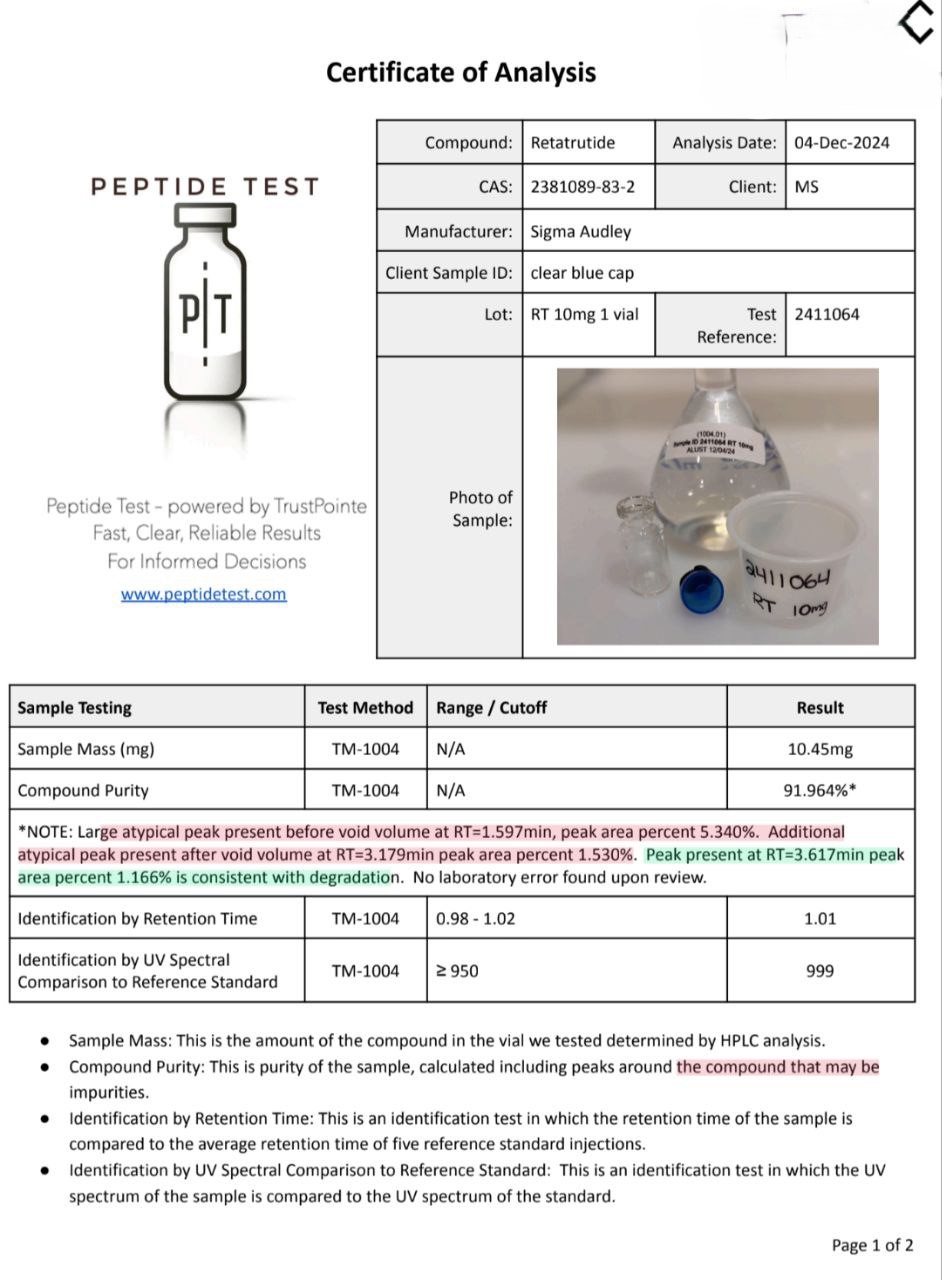
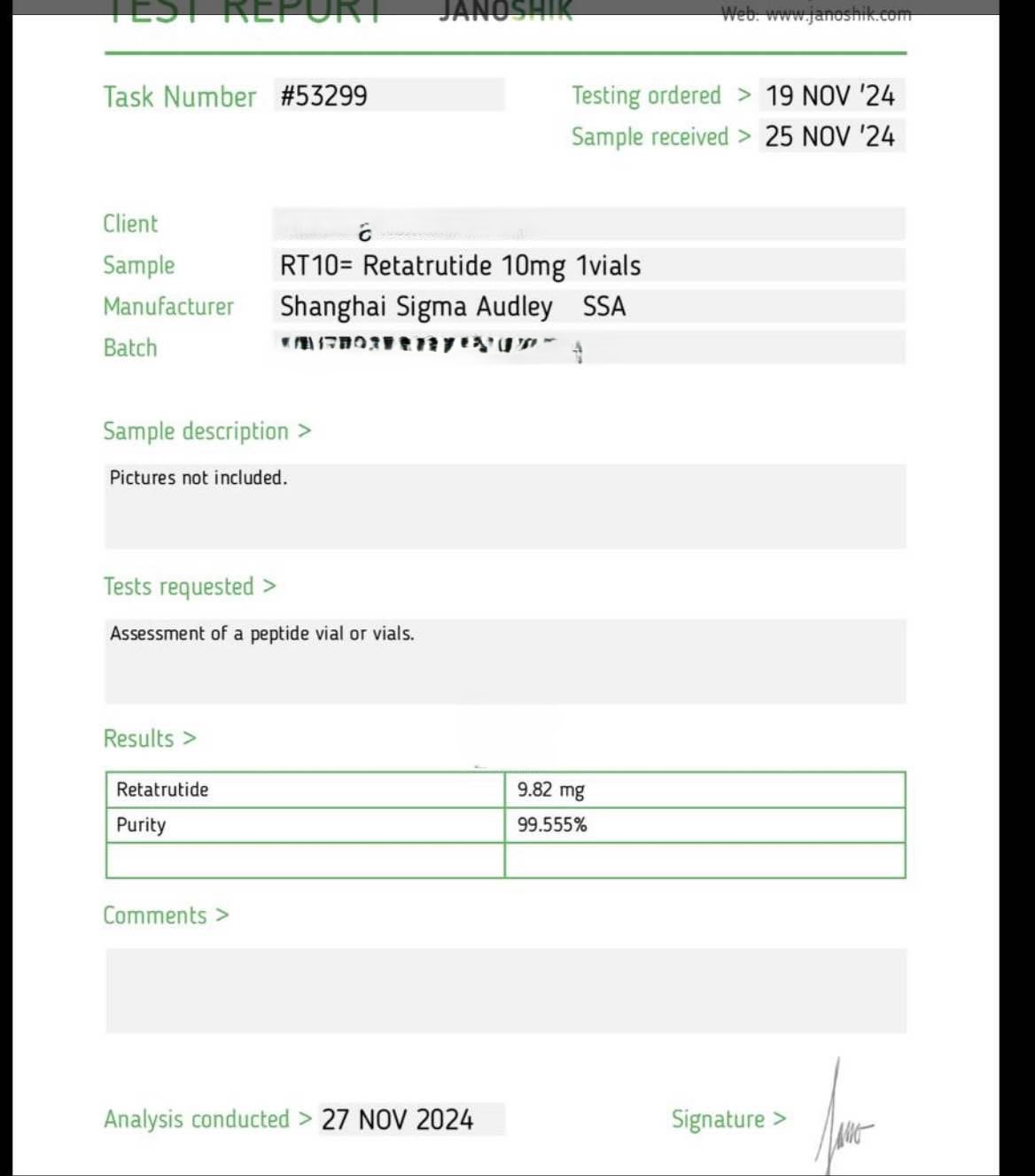
PeptideTest included two minor peaks (37.642 and 10.782), marked as unknown filler, in its total. Janoshik left them out. Take those two peaks away and the two labs agree, allowing for normal error:
648.220 ÷ (648.220 + 8.219) = 648.220 ÷ 656.439 = 98.75%
* treated as filler by PeptideTest alone.
NMR F-19
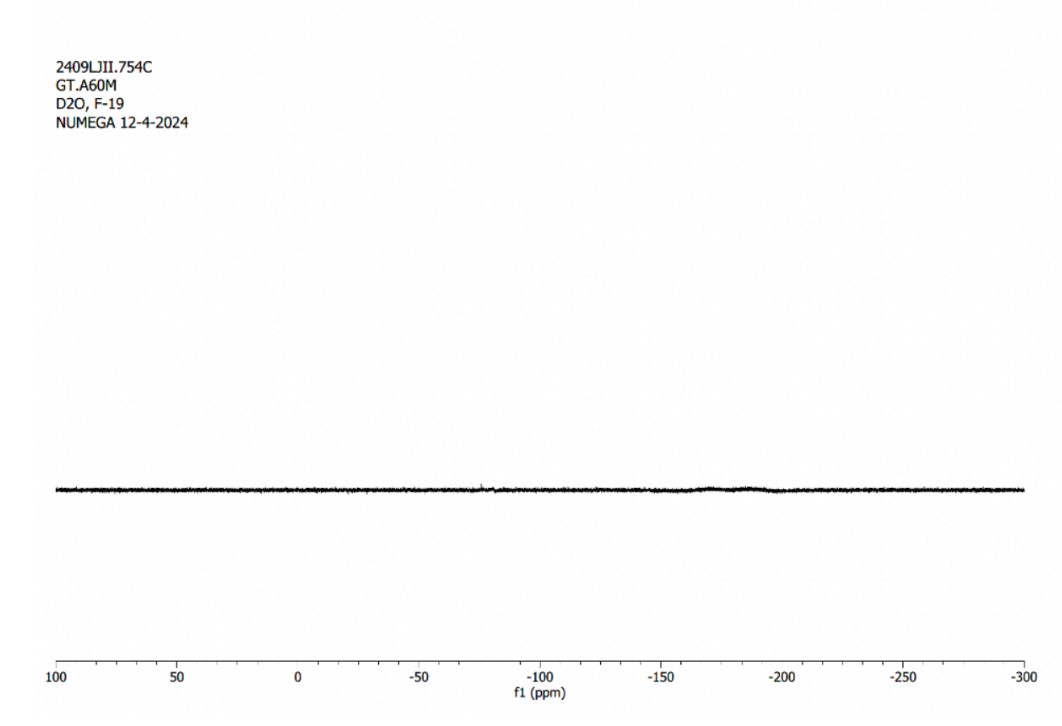
Fluorine-19 NMR finds trifluoroacetic acid and measures how much is there. TFA carries three fluorine atoms, so it produces a strong, easily recognised signal near −76 ppm. That makes the method well suited to spotting leftover TFA as well as the TFA salt form.
Endotoxin
The LAL assay picks up lipopolysaccharides, the toxic parts of bacterial cell walls, and reports them in endotoxin units (EU). Pharmacies regulated by the FDA under 503A/B work to a limit below 10 EU/mg of API when sourcing tirzepatide (source ). This guide uses that 10 EU/mg figure as its pass mark.
Gives one EU figure for the entire vial.
EU/mg = X EU ÷ Y mg
30 mg vial, 6 EU: 6 ÷ 30 = 0.2 EU/mg ✓
Gives EU/mL after dissolving the sample in 2 mL.
EU/mg = X EU/mL ÷ (Y mg / 2 mL)
30 mg vial, 8 EU/mL: 8 ÷ 15 = 0.53 EU/mg ✓
Marketplace reports
Each listing on Peptide Trades displays its lab report beside the price. So far that adds up to 170 reports covering 208 listings. The most recent:
HK PeptideSep 15, 2026
Kisspeptin-10
99.57% purity · 10.03 mg
HK PeptideSep 15, 2026
Kisspeptin-10
99.4% purity · 5.02 mg
HK PeptideSep 15, 2026
Selank
99.66% purity · 11.86 mg
HK PeptideSep 14, 2026
BPC-157 / TB-500 Blend
BPC-157 10.86 mg · TB-500 10.26 mg
HK PeptideSep 11, 2026
DSIP
99.49% purity · 14.99 mg
HK PeptideSep 1, 2026
SS-31 (Elamipretide)
99.91% purity · 10.07 mg
If an independent test finds the wrong compound or a substantial under-fill while the order is still in escrow, you can open a claim. The brand receives no payment until the claim is settled.
Written by the Peptide Trades team from public sources and community testing practice. Not medical advice.